The dining room is the most underappreciated room in the modern home. In an era of kitchen islands, breakfast bars, and living-room coffee tables, many households have allowed the dedicated dining space to become a dumping ground for mail and laptop bags. That's a significant design mistake. A well-composed dining room is one of the most powerful social and aesthetic assets a home can have.
Whether you're furnishing a formal dining room from scratch, upgrading a tired set, or bringing genuine intentionality to a space that's always felt like an afterthought, this guide covers every decision you'll need to make: the table, the chairs, the lighting, the layout, and the finishing details that elevate a functional room into a room worth sitting in.
The Table: The Most Important Piece of Furniture You'll Ever Buy for This Room
Your dining table is more than a surface. It is the architectural center of the room. Every other decision radiates outward from it. Choose it carefully, and the rest of the room falls into place. Choose it carelessly, and no amount of styling will save the space.
Getting the Size Right
Size is where most dining room mistakes begin. The most common error is buying a table that is too small for the room, resulting in a space that looks sparsely furnished rather than elegantly restrained. The general guidelines:
- Allow 36 inches minimum from the edge of the table to the nearest wall or furniture, enough for a chair to be pulled out and a person to walk behind it comfortably. 42–48 inches is ideal.
- Seat width per person: Plan for 24 inches of table width per seated diner at a minimum; 28–30 inches per person is more comfortable.
- Common table configurations: A 60-inch round table seats 4–6. A 72-inch rectangle seats 6. A 96-inch rectangle seats 8–10. A 120-inch or longer table seats 10–12.
- Measure before you buy. Place painter's tape on the floor in the table's exact footprint and walk around it at dining-chair distance. The spatial reality is always different from what you imagine.
Material: The Decision That Defines the Table's Character
The material of your dining table is its most lasting characteristic. It determines not just how the table looks but how it ages, how much maintenance it demands, and how well it holds up to daily use over a decade or more.
Solid Wood
The classic choice and still one of the most versatile. Solid hardwood (oak, walnut, maple, acacia) is warm, repairable, and genuinely improves with age. A scratch on solid wood can be sanded out; a scratch on veneer cannot. The Christopher Knight Home Acacia Wood Dining Table exemplifies this category: acacia's rich grain and warm honey tone work in traditional, transitional, and casual-modern settings alike, and the solid construction means this is a table you pass down rather than replace.
Industrial Wood & Metal
A wood-top table with a metal base offers the warmth of wood with a more structural, contemporary silhouette. This aesthetic, popular in industrial, urban-modern, and loft-style interiors, also tends to be more affordable than comparable all-wood pieces without sacrificing durability. The Tribesigns Industrial Wooden Dining Table is a strong example: the combination of the textured wood surface and the geometric metal base produces a piece that looks considered and deliberate, not budget-driven.
Sintered Stone
If you want to make a genuine design statement, sintered stone is the material of 2025–2026. Sintered stone (also called ultra-compact stone or porcelain stoneware) is engineered from natural minerals compressed at extreme heat and pressure, producing a surface that is virtually indestructible. It is heat-resistant, scratch-resistant, stain-resistant, UV-stable, and non-porous (no sealing required). Its appearance, often mimicking natural marble or quartzite with striking veining, is impossible to distinguish from the real thing at a glance, at a fraction of the maintenance cost.
The Legendstone 7-Piece Sintered Stone Dining Room Set is the standout in this category. The table features a bold marble-effect sintered stone top with dramatic natural veining, an aesthetic that photographs like a luxury hotel dining room and functions like a commercial kitchen surface. The included six upholstered chairs complete a room-ready ensemble that would be at home in a high-end city apartment or a generous suburban dining room. This is a long-term investment in a material that will outlast any wood table in the home, and it arrives as a cohesive set that eliminates the challenge of sourcing matching chairs.
Mid-Century Modern Sets
For buyers who want the complete solution (table and chairs as a designed unit), a mid-century modern dining set offers the most reliable aesthetic coherence. The Zerifevni Mid-Century Modern Dining Table Set with 4 Chairs is an excellent value proposition: the tapered legs, clean lines, and upholstered seating are hallmarks of a style that has been genuinely timeless for seven decades. This set works in contemporary apartments, transitional family homes, and smaller dining rooms where a complete, coordinated look is the priority.
Table Shape: Rectangle, Round, or Oval?
Shape affects not just aesthetics but social dynamics and spatial flow.
- Rectangle: The most common and the most versatile. Accommodates the most people per square foot. Creates a natural head-of-table formality. Best for longer, narrower dining rooms.
- Round: Inherently more democratic: no head of the table, everyone faces everyone. Creates a more intimate conversation atmosphere. Better for square rooms. Cannot be extended easily. Best for 4–6 diners.
- Oval: The sophisticated hybrid. The softened corners allow easier traffic flow than a rectangle. Works well in rooms with limited clearance. Accommodates as many people as a rectangle of equivalent length.
Dining Chairs: The Underrated Decision
Most people spend 80% of their dining room budget research time on the table and treat the chairs as an afterthought. This is backwards. You sit in the chairs. You don't sit in the table. Chair comfort, scale, and style make or break the dining experience and the room's overall aesthetic.
Upholstered vs. Hard-Seat Chairs
Hard-seat chairs (wood or metal seats) photograph beautifully but are genuinely uncomfortable for meals lasting more than 30 minutes. If you host dinner parties or enjoy long, lingering meals, upholstered seats are not a luxury; they're a functional requirement.
Upholstered dining chairs introduce fabric, which means considering cleanability. For households with children or regular entertaining, performance fabrics (microfiber, velvet-effect polyester, solution-dyed linen) are far more practical than natural fabrics. The Nrizc Velvet Dining Chairs (Set of 2) solve this elegantly: the velvet upholstery looks genuinely luxurious while the polyester construction makes them cleanable in a way that real velvet is not. Their clean-lined silhouette pairs well with both wooden and stone-top tables without competing with either.
Chair Scale and Proportion
Chair seat height should be 10–12 inches below the table surface. Most standard dining tables are 29–30 inches tall, which pairs with chairs with seat heights of 17–19 inches. If you're buying chairs separately from your table, measure both before purchasing. This pairing error is surprisingly common and results in uncomfortable seating geometry.
Chair width matters in tight rooms. Account for the full width of the chair, not just the seat, since arms extend several inches on either side. For rooms where space is tight, armless chairs allow seats to be pushed fully under the table, reclaiming significant floor space when the table is not in use.
Mixing Chair Styles
One of the most sophisticated dining room design moves is mixing chair styles: using one pair of statement armchairs at the table ends with a set of simpler side chairs along the length. This approach creates visual interest, differentiates the host and guest positions, and allows you to invest in one pair of genuinely beautiful chairs while keeping the remaining seats more budget-conscious. The contrast reads as intentional and collected rather than mismatched.
Lighting the Dining Room: The One Rule That Matters
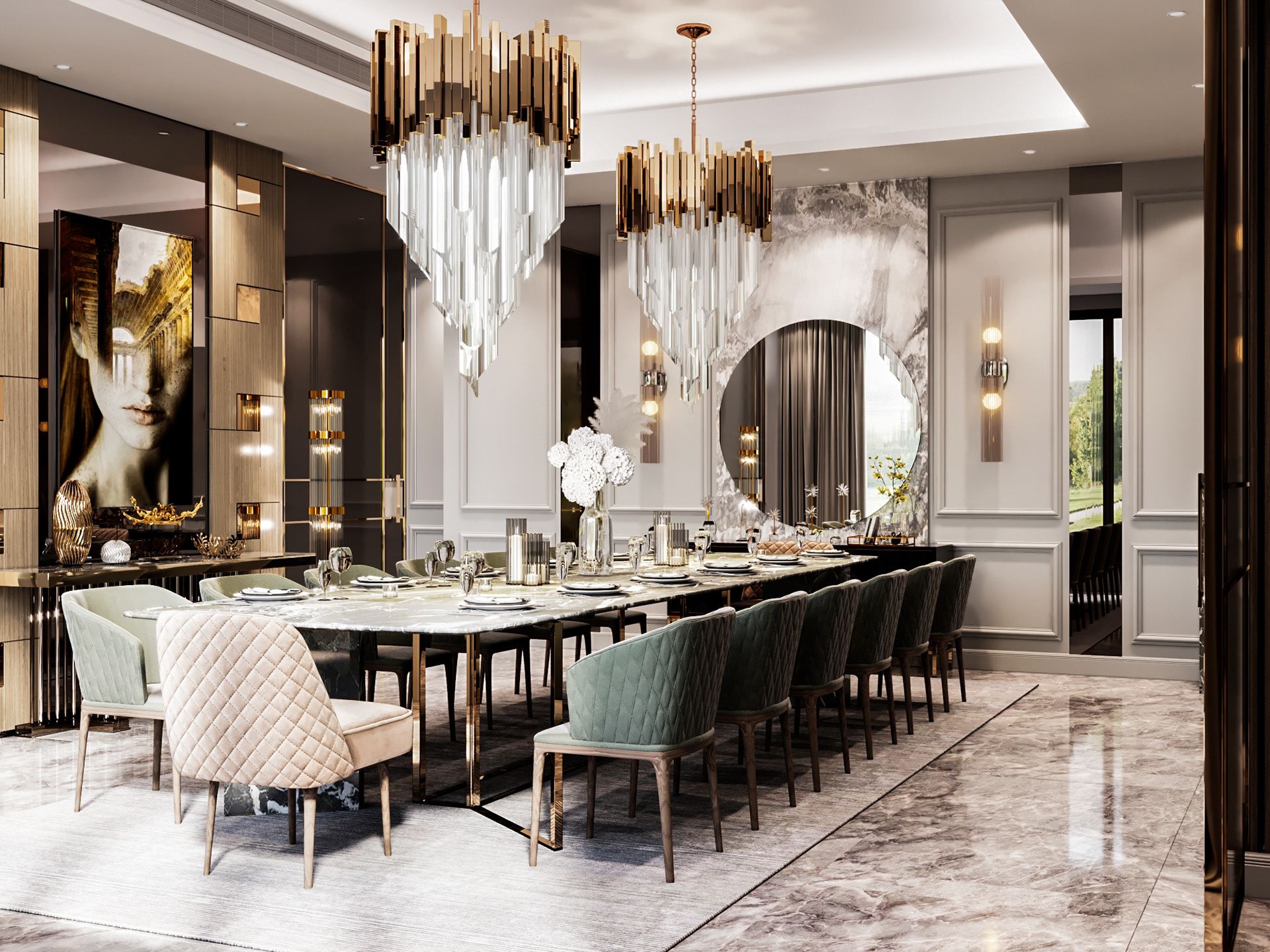
A dining room pendant or chandelier should hang 30–34 inches above the table surface. This height puts the fixture within the intimate zone of the conversation, low enough to feel immersive and high enough not to obstruct sightlines across the table.
The fixture diameter should be roughly one-half to two-thirds the table length for a rectangle, or equal to roughly half the table diameter for a round. A fixture that is slightly too large always reads better than one that is too small; designers consistently err on the side of drama.
For atmosphere, put the dining room light on a dimmer. The difference between a dining room at full brightness and one dimmed to 60% during a meal is the difference between a cafeteria and a restaurant. This single $20 upgrade changes how the room functions every evening.
See our complete layered lighting guide for detailed advice on dining room lighting design, including how to add accent lighting with buffet lamps and sconces for a fully dimensional effect.
Layout Principles for the Dining Room
A dining room layout has less complexity than a living room, but the principles still matter:
- Centre the table under the overhead light fixture, not the room. If the fixture is not centered over the table, the room reads as off-balance regardless of how beautiful the furniture is.
- Position a buffet or console table along a wall for serving surface and display space. This is one of the most functional additions to a dining room and one that most people overlook. See our console table styling guide for ideas that translate directly to a dining room buffet.
- A large mirror on a dining room wall does double duty: it visually expands the space and reflects the candlelight and pendant light, adding a warmth and sparkle that no other wall treatment matches.
- An area rug under the dining table anchors the furniture group and reduces noise. Ensure the rug extends at least 24 inches beyond the table edge on all sides so chair legs remain on the rug when chairs are pulled out. If it falls short of this, the rug looks undersized and chairs catch on the edge.
Dining Room Styling: The Finishing Details
The table itself is a surface that should be composed thoughtfully when not in use for meals. The current approach favored by interior designers: a centerpiece with genuine scale (a large vase, a cluster of candles at varying heights, a sculptural object), flanked by symmetrical table runners or a long linen or cotton runner that softens the table surface visually. Avoid the scattered arrangement of small objects that results in a table that looks like it hasn't been cleared from the last meal.
For formal dining rooms, chair cushions in a contrasting fabric, a generous tablecloth for entertaining, and a set of matching tableware on display (rather than hidden in a cabinet) reinforce the sense of occasion that makes this room worth having.
Frequently Asked Questions: Luxury Dining Room Furniture
How much should I spend on a dining table?
A dining table is a long-term investment. For solid wood tables, quality construction starts at around $500–$800 and scales to $2,000+ for premium hardwoods and designer pieces. Sintered stone tables command a premium (typically $1,500–$3,000+ for a complete set), but the zero-maintenance durability and the material's genuine luxury character justify the investment over a 15–20 year lifespan. Sets like the Legendstone Sintered Stone Dining Set represent exceptional value at their price point relative to comparable stone-top sets in specialty furniture retailers.
Is sintered stone better than marble for a dining table?
For practical purposes, sintered stone significantly outperforms natural marble. Marble is porous (absorbs wine, oil, and acidic foods), requires regular sealing, scratches with metal cutlery, and etches when exposed to citrus. Sintered stone has none of these vulnerabilities. The aesthetic difference between high-quality sintered stone and natural marble is imperceptible to most people. For a dining surface that will be used daily, sintered stone is the more intelligent choice.
How many chairs should I have at a dining table?
Buy two more chairs than the table's standard seating. A table that comfortably seats six should have eight chairs: six at the table and two stored or used elsewhere that can be pulled in for large gatherings. This prevents the embarrassing scramble of mismatched seating when the guest list exceeds expectations.
Should dining chairs match the dining table?
They don't have to match, but they should coordinate. The most successful dining room designs mix materials deliberately: a dark walnut table with light upholstered chairs, or a sintered stone table with velvet dining chairs in a complementary neutral. What to avoid: chairs that feel like they came from an entirely different design era than the table. A chrome-and-glass table paired with ornate carved-wood chairs, for example, would feel jarring regardless of how good either piece is on its own.
How do I make a small dining room feel larger?
Use a round or oval table (fewer hard corners, more traffic flow), choose transparent or ghost chairs (acrylic legs disappear visually), hang a large mirror on a wall, keep the color palette light and cohesive, and mount the overhead light slightly lower than standard to draw the eye down and compress the perceived ceiling height into a more intimate scale. See our small space design guide for additional strategies that translate directly to dining rooms.
Investment Priority: Where to Spend and Where to Save
If budget forces trade-offs, prioritize in this order:
- The table first. This is the room's anchor and the piece you'll live with longest. Under-investing here is the most regrettable dining room mistake.
- Chair comfort second. You use the chairs actively and daily. Upholstered seats that feel good over a long dinner are worth more than beautiful chairs that make you shift in discomfort within 20 minutes.
- Lighting third. A proper overhead pendant on a dimmer transforms the room's atmosphere for minimal cost.
- A buffet or sideboard fourth. This adds storage, display surface, and completes the room's furnished feeling.
- Accessories and styling last. Tableware, art, candles, and the centerpiece are the final layer. All of them are easy to evolve over time without replacing any furniture.
A dining room furnished thoughtfully, even modestly, rewards you every time you sit down to eat. The table you choose sets the tone for meals, gatherings, and all the ordinary moments that become memories in a well-loved home. Choose it as the investment it is.